
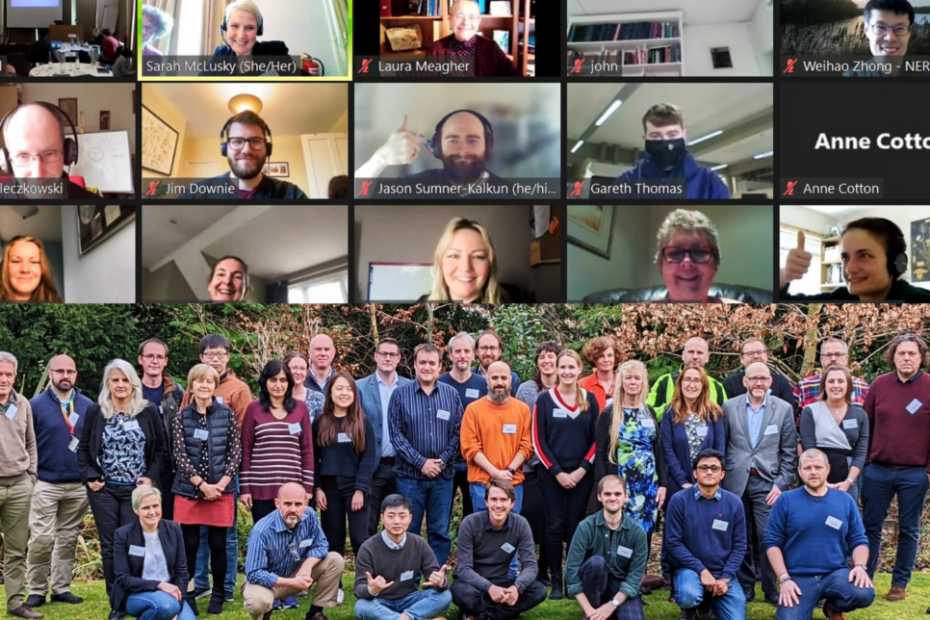
A guide to choosing the right event format for the right reason
Am I the only one who is glad that hybrid events seem to be dying a death? Back in the early post-COVID world I was involved in running a couple of hybrid events and, oh my goodness, it was hard work! You’ve probably noticed that for a ‘hybrid’ event now the online option is usually just a livestream, perhaps with a Q&A channel but no other interaction with the in-person audience.
To do a hybrid event well and genuinely engage the people both in the room and online you need three facilitators – one in the room, one online and another who is in the room, but on a laptop managing as a connector between the two spaces. Not to mention the tech set-up! It’s a level of complexity that might be feasible for the United Nations, but most research events just can’t afford.
Thankfully we’ve realised that it’s usually better to be either fully online or fully in-person and not to try and merge the two. Without skilled facilitators and professional AV support, hybrid is often the worst of both worlds. That said I also think online and in-person events have their own strengths, weaknesses and best use cases.
When to choose an online event
Online events work best for fairly straightforward information dissemination. So things like talks and lectures. They are also usually cheaper, lower risk and great for accessibility – whether that’s people who need captions or people who can’t travel due to the cost or caring responsibilities. As a result you might get a bigger or more international audience.
The downsides are that the drop-out rate will be high (usually around 50%) and your audience might or might not be paying attention. Engagement and conversation are not impossible, but they need to be very carefully managed and communicated well in advance. I’m currently working with a client to transition an in-person training course that was all about connection and community, into an online format and it is challenging, even for me!
When to choose an in-person event
In-person events should be your go-to for relationship building and collaboration whenever possible. We have evolved to be around other people in social groups. Whether we realise it or not we pick up so much information through behaviour and body language. I started teaching yoga at the end of COVID and I tried teaching online at first, but I just hated it – there is nothing like being with people in the same room to build trust, rapport and connection.
But with the resurgence in in-person events it’s worth noting that people’s standards are higher now. If someone has to arrange childcare and travel for 3 hours to sit through something that could have been a webinar they will likely leave grumpy, feeling like it was a waste of their time.
The right event for the right purpose
All of this means we need to be more mindful about choosing the right event format for the right purpose. The old way of doing things doesn’t necessarily work any more. My approach is always to start with the outcomes – why are you getting people together and what do you want them to get out of it? That should be the driver for which format you choose – not convenience, budget or habit.
And if you have no choice about that format, a focus on outcomes can help you decide on the actual content and structure of the event. And I can help too – whether it’s with event design or facilitation. Get in touch and let’s see if we can work together.
