

Why sticking to your event schedule matters and how to get back on track when things start to slide
I often joke that, on the day of an event, my job is 90% about time-keeping. Although I might say this with a smile, I am deadly serious about the importance of time-keeping. I wouldn’t dream of showing up at an event I was running without a watch and a detailed run of show. And my event kit often includes a large visual countdown timer and A4 colour-coded ‘2 Minutes’ and ‘Time’s Up’ cards.
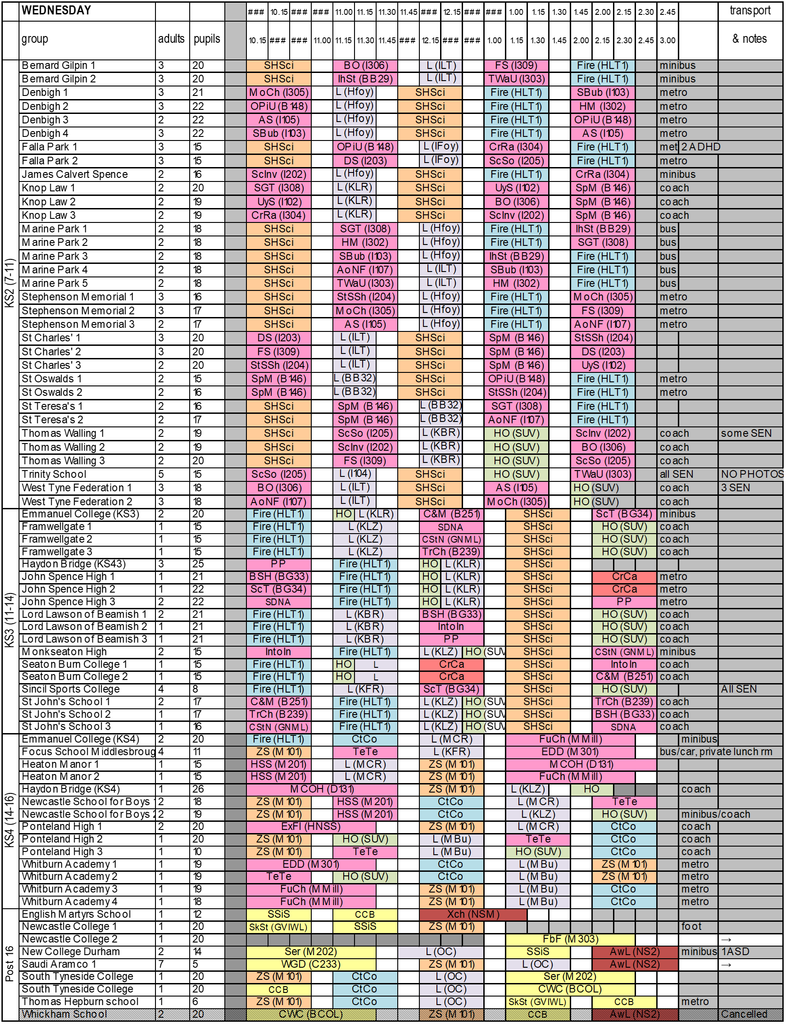
Some of it comes from running events that could easily descend into chaos. When you have 30 school groups rotating around activities across multiple venues, getting even a few minutes off track can be like knocking down the first in a line of dominoes that leads to disaster. This image is – honestly – the timetable for just one day at the biggest schools’ event I ever organised (and it was all scheduled by me and my poor brain).
Good time-keeping is a sign of respect and care
The stakes are often lower these days, although I now work mainly with adults who rightly expect their time, effort and expertise to be respected. And sticking to an event schedule is a very clear signal of respect. If one speaker is allowed to go over time, while the others stuck to the brief that can be perceived as a slight. And if the event runs into break time, or past the advertised end-time that can leave people rushing their break or bolting for their transport home. It can also lead to a restless audience who are clock-watching and shifting uncomfortably in their seats.
Trust, control and keeping our promises
But underneath all of this sits psychological safety. When a guest turns up at an event they are essentially trusting the organiser to take care of them – intellectually and physically – for the course of that experience. And the event organisers are making a promise to the audience that they will deliver on the published agenda. Whether consciously or subconsciously, we judge the competence of the event organisers by whether or not things run to time. And in turn, whether or not we can trust the event organisers to look after us, to keep us safe.
For people who don’t feel vulnerable (perhaps because they are higher status, in a familiar place, able-bodied, or neurotypical) it might not be a big deal if things run over-schedule. But for people who are already feeling a bit vulnerable, when timings go off-piste it can make them feel uncomfortable, unsafe and like things are out of control. And when people feel uncomfortable and unsafe they lose focus, disengage, clock-watch, fidget, and leave early. And this behaviour can be contagious, spreading from one audience member to another until you have a problem on your hands. You might think I’m exaggerating, but I have seen events start to spiral when just one person packed up and left (particularly if that person was high-status).
Let your schedule breathe
Of course, sometimes it is impossible – stuff happens, speakers go over time, trains run late, catering is delayed, fire alarms go off. As in previous posts about dealing with the unexpected much this comes down to planning
- Don’t pack your agenda so tightly. If you have asked a speaker to talk for 10 minutes, schedule 15 so there is time for switching between presenters and it’s a buffer if they go a minute or so over time.
- Make sure the breaks are long enough that they can be used as a cushion and if one session goes over time you can still start the next one on time. You might also need to tell delegates to come back for a certain time when you don’t actually intend to start until 5 min later.
- Use less structured time flexibly. Just because you said there would be 10 minutes of Q&A doesn’t mean you have to actually have 10 minutes. Trust me – people would rather have 5 minutes and finish on time.
- Allow adequate time for AV checks. Get the speakers to come early so you can check that their slides load correctly and they know how to use the clicker and mic. Don’t do this with everyone watching – that’s a recipe for a flustered speaker and a restless audience.
I know that, despite your best efforts, it is often the speakers who throw things off track. Handling speakers, including knowing when and how to cut them off, is a whole topic in it’s own right – stay tuned for the next newsletter to get my thoughts on that one.
But for now I will leave you with this thought. Over the years I’ve fielded a lot of complaints about events running late, but no-one has ever complained to me when an event finishes early!
Photo by Aron Visuals on Unsplash
